WISDOM TEETH

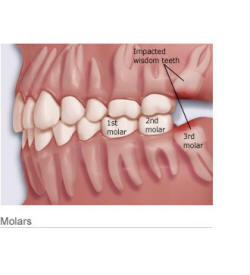
Wisdom teeth are your third molars.
Early removal of wisdom teeth, around the age of 16 or 17, can help you to avoid future problems
According to the American Association of Oral and Maxillofacial Surgeons, approximately 50 million Americans will need to have their wisdom teeth removed before the age of 25.
The average mouth has thirty-two teeth, sixteen on top and sixteen on the bottom. Each tooth has a special name and use:
|
|
The four 1st molars come in around age six and are called “six year molars”. |
|
|
The four 2nd molars come in around the age 12 and are called the “12 year molars”. |
|
|
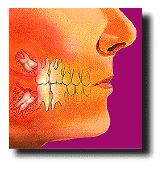
The four 3rd molars come in around the age of 17 (age range of 15-25) when most individuals become adults thus they are called “wiser or wisdom teeth”. |
American Association of Oral and Maxillofacial Surgeons recommend
evaluation of wisdom teeth by age 25
If we have enough room in the jaw the eruption of these teeth will be just a normal process of growing up. However, for allot of people only have enough room for twenty-eight teeth and there is not enough room for these teeth to erupt properly so they become impacted.
Wisdom teeth are considered “impacted“ or unable to erupt when they have no place to go or grow. They may grow in sideway (which can destroy your second molar), only partially come through the gum causing a bacteria trap resulting in recurrent infections or remain trapped beneath the gum and bone forming fluid filled sac (cyst) or tumors that destroy the jaw or teeth surrounding this area.
Wisdom teeth can be considered not functional or useful if they are:
|
|
badly decayed |
|
|
have gum disease-current data indicates that 25% of patients with third molars have considerable periodontal disease around this area**. |
|
|
cause pain |
|
|
move other teeth out of aliment |
|
|
interfere with your biting. |
Benefits of early removal of wisdom teeth, around the age of 16 or 17, can help you to avoid future problems. At a younger age:
|
|
tooth roots are not fully developed |
|
|
the surrounding bone is softer |
|
|
there is less chance of damaging nearby nerves or other structures |
|
|
there is less surgical risk |
|
|
healing is generally faster. |
They should be removed to:
|
|
Reduce the chance of unexplained pain. |
|
|
Accommodate a prosthetic appliance. |
|
|
Avoid cavities in wisdom teeth and the teeth around them. |
|
|
Avoid periodontal disease. |
|
|
Avoid biting interference . |
|
|
Avoid disruption of natural alignment causing teeth to shift. |
|
|
Avoid bone shrinkage. |
|
|
Avoid cyst formation (a sac filled with infected fluid around the crown of the tooth, like a water balloon). |
|
|
When they cannot erupt into an acceptable position. |
|
|
When the roots may not be fully developed to decrease the surgical risk involved with the procedure. |
|
|
A 20 year study revealed that out of 865 patients with broken jaws, 65% fractured their lower jaw in the area of their un-erupted wisdom teeth *** |
|
|
40% of adults that never had their wisdom teeth removed as a teen develop infection, decay or gum disease by 45 |
|
|
Avoid check biting |
|
|
25% of adults over age 40 with wisdom teeth need to have them extracted and the risk of surgical complications in these individuals increases by 30% from what it is in adolescents***. |
