Economic confidence eyed
Like many Americans, dentists were deeply affected by the recession last year and are cautious about the year ahead, judging from the response of members participating in the ADA Quarterly Survey of Economic Confidence.
“The report continues to confirm what we suspected was true, that 2009 was a difficult year for dentists,” said Dr. Christopher Larsen, a member of the Council on Dental Practice and its Subcommittee on Economic Issues. “However, most economists believe the worst of the Great Recession is behind us. Let’s continue to hope that there is no place to go but up from here.”
“The respondents also were less optimistic about future economic conditions and future gross billings than they had been previously,” says an executive summary of the 54-page report on the survey. “We also surveyed dentists about their plans for 2010. More than 25 percent expect to purchase new equipment in 2010, but about one in seven expect to reduce staff during the coming year.”
“It does look like the national treatment acceptance rate is up,” said Dr. Michael Halasz, the CDP subcommittee chair. “That’s good news for the profession and our patients. I continue to be amazed by the comprehensive data and incredible value of this report. Dentists who haven’t seen one of these reports lately really should take a look.”
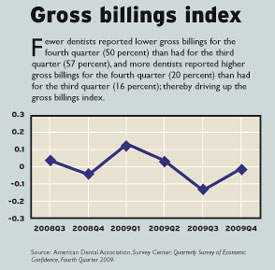
The gross billings index, for example, shows that fewer dentists reported lower and more reported higher gross billings for the fourth quarter than for the third quarter. (See chart.)
Dr. Larsen also noted that 27 percent of survey respondents expect to purchase new equipment in 2010 and said, “Hopefully, that’s a good sign for the economy.”
ADA members can link to the surveys through the Dental Practice Hub Web page www.dentalpracticehub.ada.org by selecting one of the several “Economy’s Impact” tabs or at www.ada.org/goto/freereports. There is no print report available for sale.
Recent government data show a decline in the annual dental growth rate from 6.2 percent in 2007 (over 2006) to a projected 3.2 percent growth in 2009 and 3.3 percent in 2010. The growth in overall health care spending slowed to 4.4 percent in 2008, the slowest rate of growth in 48 years.
The ADA survey indicates that the dental economy is not impervious to these recent economic trends. The survey assesses changes in dentists’ practice metrics by eight measures and captures dentists’ perceptions of their economic confidence by region and age group.
“Overall, 2009 was a very difficult year for dentists,” the survey says. “Based on responses to questions in this survey, we estimate that overall net incomes of dentists declined by more than five percent in 2009.
“Although there were pockets of prosperity, the number who reported that net income declined in 2009 was almost three times the number who reported that net income increased in 2009. New dentists, those who have been practicing for less than 10 years, were the only group who reported that net incomes had increased. Net incomes in 2009 also declined across all regions based on the responses to the survey.”
Based on responses to the Quarterly Survey of Economic Confidence Fourth Quarter 2009, conducted between Jan. 12 and Jan. 21 this year, the fourth quarter “was another difficult period for dentists” who participated in the survey. The survey includes a national representative sample of dentists active in private practice.
“Although a number of indicators moved upward, the general results were quite negative,” the survey says, citing for example:
- Net income: Some 56 percent of respondents reported that net income was down during the fourth quarter, a slight improvement relative to the prior quarter;
- Gross billings: About 50 percent indicated that gross billings were lower during the fourth quarter, which was an improvement relative to 57 percent who indicated that gross billings were lower in the third quarter;
- Acceptance rates: The percentage of dentists reporting lower treatment acceptance rates improved by 7 points from 54 percent in the third quarter to 47 percent in the fourth quarter.
The most recent National Health Expenditures data reported by government actuaries and economists with the Centers for Medicare and Medicaid Services tracks recent dental spending and average annual growth.
Dental services expenditures by calendar year and growth from prior year shown and over the projection period:
- 2007鈥?96.4 billion, 6.2 percent over 2006;
- 2008鈥?101.2 billion, 5.1 percent;
- 2009 (projected)鈥?104.4 billion, 3.2 percent;
- 2010 (projected)鈥?107.9 billion, 3.3 percent;
- 2014 (projected)鈥?135.7 billion, 5.9 percent;
- 2019 (projection period 2009-2019)鈥?180.4 billion, 5.4 percent.
(Source: Centers for Medicare and Medicaid Services, Office of the Actuary, National Health Statistics Group, and U.S. Department of Commerce, Bureau of Economic Analysis and Bureau of the Census. This data also reported in the March 2010 journal Health Affairs, “Health Spending Projections Through 2019: The Recession鈥檚 Impact Continues.”)