DENTAL CARIES IN THE COTTON EAT
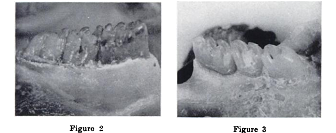
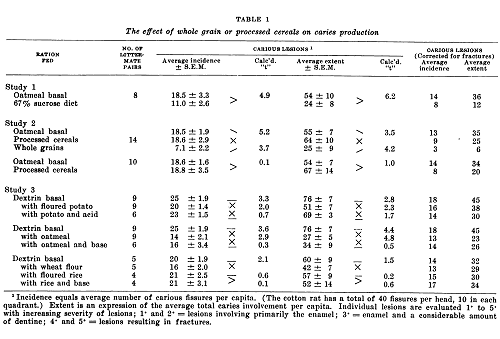
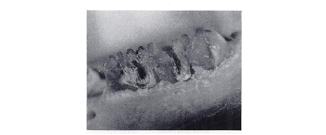
Cotton rats have been found to be highly susceptible to thecariog-enic action of a soft and finely ground natural dietconsisting- of oatmeal, dried whole milk and sugar (Constantet al., ’51). Greater tooth destruction resulted from feedinglower levels of the dried whole milk, either by increasing thecereal level or by substituting casein and dextrin for the milkportion. It seemed likely that the cereal and mineral contents of our natural diet were the factors primarily concernedin its extensive cariogenicity. The consumption of processedcereals has been considered by several investigators to be animportant factor in the increased caries incidence of manypeoples who previously had been relatively caries-free (Os-born and Noriskin, ’37; Stephan, ’48). We wish to reportfurther studies on the [NextPage]caries-producing activity of processedor whole cereals when fed to cotton rats.1Published with the approval of the Director of the Wisconsin AgriculturalExperiment Station. Supported in part by grants from the Nutrition Foundation,Inc., New York, N. Y., and the National Dairy Council, Chicago, III.We are indebted to Merck and Co., Hahway, New Jersey, for the crystallinevitamins and to Abbott Laboratories, North Chicago, Illinois, for the halibutliver oil.Cotton rats have been found to be highly susceptible to thecariog-enic action of a soft and finely ground natural dietconsisting- of oatmeal, dried whole milk and sugar (Constantet al., ’51). Greater tooth destruction resulted from feedinglower levels of the dried whole milk, either by increasing thecereal level or by substituting casein a[NextPage]nd dextrin for the milkportion. It seemed likely that the cereal and mineral contents of our natural diet were the factors primarily concernedin its extensive cariogenicity. The consumption of processedcereals has been considered by several investigators to be animportant factor in the increased caries incidence of manypeoples who previously had been relatively caries-free (Os-born and Noriskin, ’37; Stephan, ’48). We wish to reportfurther studies on the caries-producing activity of processedor whole cereals when fed to cotton rats.1Published with the approval of the Director of the Wisconsin AgriculturalExperiment Station. Supported in part by grants from the Nutrition Foundation,Inc., New York, N. Y., and the National Dairy Council, Chicago, III.We are indebted to Merck and Co., Hahway, [NextPage]New Jersey, for the crystallinevitamins and to Abbott Laboratories, North Chicago, Illinois, for the halibutliver oil.Cotton rats have been found to be highly susceptible to thecariog-enic action of a soft and finely ground natural dietconsisting- of oatmeal, dried whole milk and sugar (Constantet al., ’51). Greater tooth destruction resulted from feedinglower levels of the dried whole milk, either by increasing thecereal level or by substituting casein and dextrin for the milkportion. It seemed likely that the cereal and mineral contents of our natural diet were the factors primarily concernedin its extensive cariogenicity. The consumption of processedcereals has been considered by several investigators to be animportant factor in the increased caries incidence of manypeoples who previous[NextPage]ly had been relatively caries-free (Os-born and Noriskin, ’37; Stephan, ’48). We wish to reportfurther studies on the caries-producing activity of processedor whole cereals when fed to cotton rats.1Published with the approval of the Director of the Wisconsin AgriculturalExperiment Station. Supported in part by grants from the Nutrition Foundation,Inc., New York, N. Y., and the National Dairy Council, Chicago, III.We are indebted to Merck and Co., Hahway, New Jersey, for the crystallinevitamins and to Abbott Laboratories, North Chicago, Illinois, for the halibutliver oil.Weanling cotton rats (19 to 21 days of age) from our stockcolony were used in these experiments. Stock animals andyoung were maintained on a non-cariogenic stock diet. Weanlings were distributed by litter-mate pairs among t[NextPage]he controland experimental groups because of the observations madeby Schweigert et al. (’45) that cotton rats from differentparental stock varied in their susceptibility to cariogenicdiets. All animals were fed and watered ad libitum and weregiven two drops of haliver oil each week.In the first study the cariogenicity of the oatmeal diet wascompared with that of a partially synthetic, high sucrose diet.The partially synthetic diet contained 67% sucrose, 24Êsein, 4% salts IV (Phillips and Hart, ’35, patterned afterthe salts of milk), 5% corn oil, adequate levels of B vitamins(Shaw et al., ’44) and 4% 1: 20 liver extract. The cereal dietconsisted of 50% oatmeal, 32% dried whole milk and 18%sucrose. The total sugar content of this diet was 30% (18%sucrose and 12% lactose). The animals w[NextPage]ere kept on experiment 14 weeks.The dental caries scores of these animals are given in table1. Both diets were equally acceptable to the animals, whichshowed normal and comparable weight gains. Contrary toexpectations, the caries scores revealed that the 67% sucrosediet was less cariogenic than the cereal-milk diet. When the67% sucrose diet was fed, there were 38% fewer cariousfissures and a 50% reduction in the severity of the lesions.These results suggested that the cereal part of the rationcontributed to its cariogenicity.A second study was then conducted to determine whetherthe cariogenicity of the cereal used was characteristic ofcereals in general. Various whole grain or processed cerealswere fed at a level of 50% in the above cereal diet. Litter-matepairs were fed whole corn or corn[NextPage] flakes, whole wheat orwheat flakes, and whole oats, with control animals receivingoatmeal (4 to 5 pairs in each group). In order to maintaindiets of similar consistency and particle size, the whole oator wheat grains and oatmeal were ground in a Wiley milluntil they passed through a fine screen (approximately 60mesh). The more brittle and fracturing cereals, whole cornand corn or wheat flakes, were reduced to a flour in a ball mill.The experimental period was 14 weeks.With the exception of whole oats or corn flakes, which resulted in a decreased growth rate, the feeding of the variouscereals in the cereal-milk diet resulted in good growth of theanimals. That the difference in growth was not part of thecaries picture was shown when the teeth were evaluated forcaries. The teeth of the anima[NextPage]ls fed corn flakes were extensively carious, while those of the animals fed whole oats hadlittle decay. The caries scores of the animals fed the wholegrain or processed cereals are summarized in table 1. Thesedata revealed that whole grains were less cariogenic than theprocessed cereals. The average number and extent of thecarious fissures were 50% less when the diet contained wholegrains than when it contained processed cereal products.The variation in caries scores when the diets contained wholegrains and the increased number of fractured cusps whenthe diet contained corn or wheat flakes suggested that someof the caries found accompanying the fractured cusps mayhave been due directly to the fracture, which was an uncontrollable physical variant. The data were recalculated toevaluate the [NextPage]caries involvement of intact teeth by eliminatingthe caries in fractured cusps from the total score. Thesecorrected caries scores, given in table 1, did not alter thecaries evaluation. The diets which contained processed cerealsstill resulted in considerably more carious fissures, excludingthose in fractured cusps. Thus the extensive cariogenicityof oatmeal was shown to be a general characteristic of processed cereals. It should be pointed out that these experimentsindicate that the cariogenicity of a given diet is not contingentsolely upon the type and amount of carbohydrate used.Larson (’49) observed that Hawaiian natives eating taro(alkaline ash) generally had considerably less tooth decaythan those consuming- rice (acid ash). Therefore a furtherstudy was made of the cereal portion of t[NextPage]he ration by comparing the cariogenicity of acid residue cereals with that ofalkaline residue foods when each was incorporated in a partially synthetic diet as the major source of carbohydrate. Thebasal diet for these experiments was formulated to approximate the composition of the cereal-milk diet used in the previous experiments. It consisted of 17% casein, 5% celln flour,53% floured dextrin, 18% sucrose, 2% salts IV, 5% corn oil,and adequate levels of B vitamins. The various cereals usedwere substituted for the floured dextrin of the basal diet.In order to maintain approximately equivalent levels of protein and carbohydrate, the casein level was decreased to 12%and the amount of cellu flour raised correspondingly to 10%in the experimental diets.Potatoes were used as representative of an[NextPage] alkaline-ashfood. These were cooked, peeled, dried, and then reduced to aflour in a ball mill. “NVheat flour, rice flour, and finely g’roundoatmeal were used as representative acid-ash foods. Theash character of some of these foods was altered by the addition of acid or base. An aqueous solution of 1 X HC1 or l NNaOH was dispersed by pipette through the cereal in suchquantity as to provide an excess of 0.1 equivalent of acid orbase per 100 gm of cereal. The treated cereals were then driedand reground before being mixed in the diet. These dietswere fed for from 10 to 12 weeks.The caries scores given in table 1 showed that the cario-genic activities of potatoes, rice, wheat and dextrin weresimilar. Under the conditions of these experiments, oatmealproduced less caries than the other foods. [NextPage]It is of interestto point out and emphasize that oatmeal was the only foodwhich was not reduced to a flour, and therefore was of coarserparticle size. The destructive effect of the basal diet, whoselargest particles were provided by the casein, is shown infigure 1. Altering the ash character of these foods by the addition of acid or base did not alter their cariogenicity. Hence,the acid or alkaline ash residue effect of the foods studiedthan those consuming- rice (acid ash). Therefore a furtherstudy was made of the cereal portion of the ration by comparing the cariogenicity of acid residue cereals with that ofalkaline residue foods when each was incorporated in a partially synthetic diet as the major source of carbohydrate. Thebasal diet for these experiments was formulated to approximate [NextPage]the composition of the cereal-milk diet used in the previous experiments. It consisted of 17% casein, 5% celln flour,53% floured dextrin, 18% sucrose, 2% salts IV, 5% corn oil,and adequate levels of B vitamins. The various cereals usedwere substituted for the floured dextrin of the basal diet.In order to maintain approximately equivalent levels of protein and carbohydrate, the casein level was decreased to 12%and the amount of cellu flour raised correspondingly to 10%in the experimental diets.Potatoes were used as representative of an alkaline-ashfood. These were cooked, peeled, dried, and then reduced to aflour in a ball mill. “NVheat flour, rice flour, and finely g’roundoatmeal were used as representative acid-ash foods. Theash character of some of these foods was altered by the addition[NextPage] of acid or base. An aqueous solution of 1 X HC1 or l NNaOH was dispersed by pipette through the cereal in suchquantity as to provide an excess of 0.1 equivalent of acid orbase per 100 gm of cereal. The treated cereals were then driedand reground before being mixed in the diet. These dietswere fed for from 10 to 12 weeks.The caries scores given in table 1 showed that the cario-genic activities of potatoes, rice, wheat and dextrin weresimilar. Under the conditions of these experiments, oatmealproduced less caries than the other foods. It is of interestto point out and emphasize that oatmeal was the only foodwhich was not reduced to a flour, and therefore was of coarserparticle size. The destructive effect of the basal diet, whoselargest particles were provided by the casein, is shown infigu[NextPage]re 1. Altering the ash character of these foods by the addition of acid or base did not alter their cariogenicity. Hence,the acid or alkaline ash residue effect of the foods studiedhad no measurable influence upon the cariogenicity of thesefoods.The lack of plaque material on the teeth of the above animals (fig. 1) showed that the heavy yellow-brown materialand the deep yellow-brown pigmentation of the lesions associated with the feeding of the 67% sucrose diet (fig. 2) wereprimarily due to inclusion of liver extract in the latter diet.The marked degree of softening of the wide enamel portionof the tooth, the paleness of the lesions and the “bleached”appearance of the teeth (fig. 3) have been found to date to beFig. 1 Mandibular teeth of a cotton rat fed the basal ration containing dextrin[NextPage]in the form of a fine flour, without liver extract.associated with the feeding of diets with a high oatmeal andlow mineral content.DISCUSSIONIt is evident from the experimental procedure used thatthe cotton rats in these studies constantly consumed the samediet as their only source of nutrients for the entire experimental period. In this respect the results obtained from thesestudies cannot be applied directly to caries production inhumans, for one would not expect humans to consume theseproportions of foodstuffs each meal of the day, or for severaldays. However, the basic findings of these studies a€” that isthe greater cariogenicity of processed cereals and the unpre-had no measurable influence upon the cariogenicity of thesefoods.The lack of plaque material on the teeth of the above ani[NextPage]mals (fig. 1) showed that the heavy yellow-brown materialand the deep yellow-brown pigmentation of the lesions associated with the feeding of the 67% sucrose diet (fig. 2) wereprimarily due to inclusion of liver extract in the latter diet.The marked degree of softening of the wide enamel portionof the tooth, the paleness of the lesions and the “bleached”appearance of the teeth (fig. 3) have been found to date to beFig. 1 Mandibular teeth of a cotton rat fed the basal ration containing dextrinin the form of a fine flour, without liver extract.associated with the feeding of diets with a high oatmeal andlow mineral content.DISCUSSIONIt is evident from the experimental procedure used thatthe cotton rats in these studies constantly consumed the samediet as their only source of nutrients for the[NextPage] entire experimental period. In this respect the results obtained from thesestudies cannot be applied directly to caries production inhumans, for one would not expect humans to consume theseproportions of foodstuffs each meal of the day, or for severaldays. However, the basic findings of these studies a€” that isthe greater cariogenicity of processed cereals and the unpre-had no measurable influence upon the cariogenicity of thesefoods.The lack of plaque material on the teeth of the above animals (fig. 1) showed that the heavy yellow-brown materialand the deep yellow-brown pigmentation of the lesions associated with the feeding of the 67% sucrose diet (fig. 2) wereprimarily due to inclusion of liver extract in the latter diet.The marked degree of softening of the wide enamel portionof the [NextPage]tooth, the paleness of the lesions and the “bleached”appearance of the teeth (fig. 3) have been found to date to beFig. 1 Mandibular teeth of a cotton rat fed the basal ration containing dextrinin the form of a fine flour, without liver extract.associated with the feeding of diets with a high oatmeal andlow mineral content.DISCUSSIONIt is evident from the experimental procedure used thatthe cotton rats in these studies constantly consumed the samediet as their only source of nutrients for the entire experimental period. In this respect the results obtained from thesestudies cannot be applied directly to caries production inhumans, for one would not expect humans to consume theseproportions of foodstuffs each meal of the day, or for severaldays. However, the basic findings of these studies [NextPage]a€” that isthe greater cariogenicity of processed cereals and the unpre-dictability of the cariogenicity of diets on the basis of theircarbohydrate content a€” apply rather universally to caries ithe human.In a review of various saccharides and dental caries studies,Stephan ( ’48) discussed several in vitro experiments whichshowed that not all Lactobacillus organisms fermented lactoseunder the given conditions, and that oral microorganismsproduced pH changes more slowly with lactose than otherdisaccharides. Polvsaccharides were much more inert. Ac-Figure 2 Figure 3Fig. 2 Mandibular teeth of a cotton rat fed a synthetic diet containing 4%liver extract powder.Fig. 3 Mandibular teeth of a cotton rat fed a low mineral oatmeal dietwithout liver extract. Note softness of outer cusp, which permit[NextPage]ted easy penetration by a no. 42 fine wire dental probe.cording to these findings, the natural diet containing processedcereals used in these experiments should have been less cario-genic than the synthetic diet. Both diets contained 67% carbohydrate but in the synthetic diet all the carbohydrate waspresent as sucrose, whereas in the natural diet only 30% wassugar (18% sucrose, 12% lactose). However, in the courseof investigating the role of nutrition in caries production incotton rats in this laboratory, Zepplin et al. ( ’50) observedthat natural diets containing 17% sucrose were more cario-genic than a synthetic diet containing 67% sucrose. The nat-ural diets used by Zepplin et al. resembled the average humandietary as closely as possible within the limitations imposedby the use of exper[NextPage]imental animals. The results of the presentstudy confirm those of Zepplin et al. and further support theobservation made previously (Constant et al., ’51) that undercertain conditions complex carbohydrates may be as cario-genic as simple sugars.Work in this laboratory has shown that the physical stateof the diet (Anderson et al., ’48; Smith, ’48; Constant et al.,’51), and the ratio of cariogenic to anti-cariogenic nutrients(Schweigert et al., ’46; Constant, ’51), as well as the totalamount of carbohydrate or fermentable sugar, may alter theextent of caries production. The protein, carbohydrate, andfat levels of the natural and the 67% sucrose diets employedwere similar. Smith (’48) found that dextrin in the form ofa fine flour resulted in approximately twice as many cariousfissures as less[NextPage] finely ground dextrin. In addition to the effectof different particle sizes and impaction, Hoppert et al. ( ’32)noted the influence of another type of retention due to plasticity and adhesiveness. Data obtained in this laboratory(Constant, ’51) have shown that higher levels of calcium orthe feeding of highly basic salts considerably reduced cariesproduction by high sucrose or high cereal diets. It is of interest to point out that the 67% sucrose diet contained twiceas much minerals as the natural diet. Although the influenceof the differences in the physical characters of the naturaland the synthetic diets cannot be properly evaluated at thistime, it is suggested that the primary cause of the greatercariogenicity of the natural diet is the decreased bufferingand neutralizing capacity of t[NextPage]his diet. This is either due toits lower mineral content or the unavailability of the mineralspresent.With respect to the greater cariogenicity of processedcereals in comparison to whole grains, Osborn and co-workers(Osborn et al., ’37; Osborn and Noriskin, ’37) concluded asa result of in vivo and in vitro experiments that this greatercariogeiiicity was due to the loss of minerals, particularlycalcium and phosphorus. The mineral content of the variouscereal diets used by us was very similar, due to the presenceof 32% milk. This level of milk (providing minerals approximately equivalent to 2% salts IV) was sufficient to result ina normal ash content of the femurs (63 to 67%). The dietswere essentially identical except for the type of cereal fed.Although the local action of minerals intimate[NextPage]ly associatedwith the carbohydrate portion of the diet cannot be ignored,the results of the present studies suggest that during therefining process the complex carbohydrates are dextrinizedto such an extent that processed cereals are more readilyavailable to and utilized by caries-producing organisms. Wealso cannot exclude at this time the possibility that refiningprocesses may be exerting an influence by other means, suchas the destruction of natural antibiotics or enzyme factors.Additional study is being made of natural and processedfoods in order to elucidate further their influence on the dentalcaries process.SUMMARYThe effect of whole grain versus processed cereals andalkaline-ash versus acid-ash foods on the experimental production of dental caries in the cotton rat has been studied.[NextPage]When fed under similar conditions, the whole grain cereals,corn, wheat and oats, were found to be less cariogenic in eachcase than their processed products a€” corn flakes, wheat flakeand oatmeal, respectively.Natural diets which contained processed cereals and only30% sugar were found to be more cariogenic than a syntheticdiet containing 67% sucrose. The reasons for this ratherunexpected finding have been discussed.A significant difference was not found between the cario-genicity of alkaline-ash and that of acid-ash foods under theexperimental conditions used.Changes in the appearance of the teeth and the cariouslesions, due to dietary ingredients, have been noted.ANDERSON, E. P., J. K. SMITH, C. A. ELVEHJEMANDP. H. PHILLIPS 1948 Dentalcaries in the cotton rat. X. The effect of fluidity o[NextPage]f the ration. J.Nutrition, 35: 371-377.CONSTANT,M. A. 1951 Studies of factors influencing the production of dentalearies and tissue calcification in the cotton rat. Ph.D. thesis, University of Wisconsin.CONSTANT,M. A., P. H. PHILLIPS ANDC. A. ELVEHJEM 1951 Dental earies inthe cotton rat. XII. Natural versus refined sugars. J. Nutrition, 43:551-564.HOPPERT,C. A., P. A. WEBEKANDT. L. CANIFF 1932 The production of dentalcaries in rats fed an adequate diet. J. Dent. Bes., 12: 161-173.LARSEN,N. P. 1949 Tooth decay in relation to diet and general health. J. Am.Med. Assn., 137: 832-838.OSBORN,T. W. B., ANDJ. N. NoRiSKiN 1937 The relation between diet andcaries in the South African Bantu. J. Dent. Bes., 16: 431-442.OSBORN,T. W. B., J. N. NORISKIN AND J. STAZ 1937 Inhibitin in vitro ofd??calcificat[NextPage]ionin teeth. Ibid., 16: 545-550.PHILLIPS, P. H., ANDE. B. HART 1935 The effect of organic dietary constituentsupon chronic fluorine toxicosis in the rat. J. Biol. Chem., 109: 657-663.SCHWEIGERT, B. S., J. H. SHAW, C. A. ELVEHJEM AND P. H. PHILLIPS 1945Dental caries in the cotton rat. V. Influence of strain variation on thecaries susceptibility. Proc. Soc. Exp. Biol. Med., 59: 44-47.SCHWEIGERT, B. S., J. H. SHAW,M. ZEPPLINANDC. A. ELVEHJEM 1946 Dentalcaries in the cotton rat. VI. The effect of the amount of protein, fat,and carbohydrate in the diet on the incidence and extent of cariouslesions. J. Nutrition, 31: 439-447.SHAW, J. H., B. S. SCHWEIGERT, J. M. MC!NTIRE, C. A. ELVEHJEM AND P. H.PHILLIPS 1944 Dental caries in the cotton rat. I. Methods ofstudy and preliminary nutritional requirem[NextPage]ents. J. Nutrition, 28:333-345.SMITH, J. K. 1948 Physical state of the ration influencing dental caries in thecotton rat. M.S. Thesis, University of Wisconsin.STEPHAN,R. M. 1948 Relative importance of polysaccharides, disaccharides andmonosaccharides in the production of caries. J. Am. Dent. Assn., 37:530-536.ZEPPLIN,M., J. K. SMITH, H. T. PARSONS,P. H. PHILLIPS ANDC. A. ELVEHJEM1950 Dental caries in the cotton rat. XI. The effect of feeding anatural diet comparable to a human diet. J. Nutrition, 40: 203-211.