2007北京太奇培训学校考研英语强化班授课讲义(六)
2007北京太奇培训学校考研英语强化班授课讲义(六)
2007 – KY– 6 内部资料 翻印必究
I. Reading Comprehension:
[2006, RC Text 4]
Many things make people think artists are weird. But the weirdest may be this: artists’ only job is to explore emotions, and yet they choose to focus on the ones that feel bad.
This wasn’t always so. The earliest forms of art, like painting and music, are those best suited for expressing joy. But somewhere from the 19th century onward, more artists began seeing happiness as meaningless, phony or, worst of all, boring, as we went from Wordsworth’s daffodils to Baudelaire’s flowers of evil.
You could argue that art became more skeptical of happiness because modern times have seen so much misery. But it’s not as if earlier times didn’t know perpetual war, disaster and the massacre of innocents. The reason, in fact, may be just the opposite: there is too much damn happiness in the world today.
After all, what is the one modern form of expression almost completely dedicated to depicting happiness? Advertising. The rise of anti-happy art almost exactly tracks the emergence of mass media, and with it, a commercial culture in which happiness is not just an ideal but an ideology.
People in earlier eras were surrounded by reminders of misery. They worked until exhausted, lived with few protections and died young. In the West, before mass communication and literacy, the most powerful mass medium was the church, which reminded worshippers that their souls were in danger and that they would someday be meat for worms. Given all this, they did not exactly need their art to be a bummer too.
Today the messages the average Westerner is surrounded with are not religious but commercial, and forever happy. Fast-food eaters, news anchors, text messengers, all smiling, smiling, smiling. Our magazines feature beaming celebrities and happy families in perfect homes. And since these messages have an agenda — to lure us to open our wallets — they make the very idea of happiness seem unreliable. “Celebrate!” commanded the ads for the arthritis drug Celebrex, before we found out it could increase the risk of heart attacks.
But what we forget — what our economy depends on us forgetting — is that happiness is more than pleasure without pain. The things that bring the greatest joy carry the greatest potential for loss and disappointment. Today, surrounded by promises of easy happiness, we need art to tell us, as religion once did, Memento mori: remember that you will die, that everything ends, and that happiness comes not in denying this but in living with it. It’s a message even more bitter than a clove cigarette, yet, somehow, a breath of fresh air. (433 words)
Notes: weird adj. 不可思议的,离奇古怪的。phony (=phoney) 假装的,冒充的,伪造的。Wordsworth (1770 – 1850) 英国诗人。daffodil n.水仙花。Baudelaire (1821 – 1867) 法国诗人及散文家。damn adj. (表示不满、愤怒、不耐烦等):Where is that damn book? 那本该死的书在哪里?My damn car has broken down! 我的混账汽车坏了。memento 纪念品。Memento mori人总有一死。
1. By citing the examples of poets Wordsworth and Baudetaire, the author intends to show that
[A] poetry is not as expressive of joy as painting or music.
[B] art grows out of both positive and negative feelings.
[C] poets today are less skeptical of happiness.
[D] artists have changed their focus of interest.
2. The word “bummer” (Line 4, Paragraph 5) most probably means something
[A] religious. [B] unpleasant. [C] entertaining. [D] commercial.
3. In the author’s opinion, advertising
[A] emerges in the wake of the anti-happy art. [B] is a cause of disappointment for the general public.
[C] replaces the church as a major source of information. [D] creates an illusion of happiness rather than happiness itself.
4. We can learn from the last paragraph that the author believes
[A] happiness more often than not ends in sadness. [B] the anti-happy art is distasteful but refreshing.
[C] misery should be enjoyed rather than denied. [D] the anti-happy art flourishes when economy booms.
5. Which of the following is true of the text?
[A] Religion once functioned as a reminder of misery. [B] Art provides a balance between expectation and reality.
[C] People feel disappointed at the realities of modem society [D] Mass media are inclined to cover disasters and deaths.
Text 2
[2005, RC Text 4]
Americans no longer expect public figures, whether in speech or in writing, to command the English language with skill and gift. Nor do they aspire to such command themselves. In his latest book, Doing Our Own Thing. The Degradation of Language and Music and Why We Should, Like, Care, John McWhorter, a linguist and controversialist of mixed liberal and conservative views, sees the triumph of 1960s counter-culture as responsible for the decline of formal English.
Blaming the permissive 1960s is nothing new, but this is not yet another criticism against the decline in education. Mr. McWhorter’s academic specialty is language history and change, and he sees the gradual disappearance of “whom”, for example, to be natural and no more regrettable than the loss of the case-endings of Old English.
But the cult of the authentic and the personal, “doing our own thing”, has spelt the death of formal speech, writing, poetry and music. While even the modestly educated sought an elevated tone when they put pen to paper before the 1960s, even the most well regarded writing since then has sought to capture spoken English on the page. Equally, in poetry, the highly personal, performative genre is the only form that could claim real liveliness. In both oral and written English, talking is triumphing over speaking, spontaneity over craft.
Illustrated with an entertaining array of examples from both high and low culture, the trend that Mr. McWhorter documents is unmistakable. But it is less clear, to take the question of his subtitle, why we should, like, care. As a linguist, he acknowledges that all varieties of human language, including non-standard ones like Black English, can be powerfully expressive — there exists no language or dialect in the world that cannot convey complex ideas. He is not arguing, as many do, that we can no longer think straight because we do not talk proper.
Russians have a deep love for their own language and carry large chunks of memorized poetry in their heads, while Italian politicians tend to elaborate speech that would seem old-fashioned to most English-speakers. Mr. McWhorter acknowledges that formal language is not strictly necessary, and proposes no radical education reforms — he is really grieving over the loss of something beautiful more than useful. We now take our English “on paper plates instead of china”. A shame, perhaps, but probably an inevitable one. (391 words)
Notes: aspire to (after) 渴望成就…。degradation n. 退化;堕落,贬低,降低。permissive 放任的。specialty (=speciality)专业。no more … than …与…一样都不…。cult n. 膜拜。authentic adj. 真实的。spell vt. 招致;意味着。elevated adj. 高架的;有修养的。put pen to paper(开始)写信。performative 有表演力的。genre 种类;风格,体裁。triumph over胜过。spontaneity 自发性。craft工艺性。 entertaining adj. 令人感兴趣的。array n. 系列;大量。subtitle 副标题。dialect 方言。think straight 有条理地思维。talk proper 说话规范。chunk n. 相当数量。
1. According to McWhorter, the decline of formal English
[A] is inevitable in radical education reforms. [B] is but all too natural in language development.
[C] has caused the controversy over the counter-culture. [D] brought about changes in public attitudes in the 1960s.
2. The word “talking” (Line 4, Paragraph 3) denotes
[A] modesty. [B] personality. [C] liveliness. [D] informality.
3. To which of the following statements would McWhorter most likely agree?
[A] Logical thinking is not necessarily related to the way we talk.
[B] Black English can be more expressive than standard English.
[C] Non-standard varieties of human language are just as entertaining.
[D] Of all the varieties, standard English can best convey complex ideas.
4. The description of Russians’ love of memorizing poetry shows the author’s
[A] interest in their language. [B] appreciation of their efforts.
[C] admiration for their memory. [D] contempt for their old-fashionedness.
5. According to the last paragraph, “paper plates” is to “china” as
[A] “temporary” is to “permanent”. [B] “radical” is to “conservative”.
[C] “functional” is to “artistic”. [D] “humble” is to “noble”.
Word Study
command [k m nd] v. 1.命令,吩咐:I command you to start at once.(我命令你立即出发。) She commanded that we (should) attack at once.(她命令我们立即进攻。) He commanded silence.(他吩咐安静。) 2.指挥(部队),控制:General Smith commanded the army. (史密斯将军指挥军队。) 3.掌握,支配: He commands a large vocabulary. (他掌握大量词汇。) 4.得到,值得(尊敬,同情等):This great man is able to command everyone’s respect. (这位伟人能得到人人尊敬。) 5.俯瞰(因而可以控制):The castle commanded the whole town. (这个城堡俯瞰整个城镇。) n. 命令;指挥;掌握,控制;司令部,指挥部。成语 at sb’s command 听候差遣[吩咐],由…掌握:I’m at your command. (我听你的差遣。) by sb’s command 根据…的命令:It was done by the Queen’s command. (这是按女王命令办的。) in command (of) 指挥,控制:Who is in command here?(谁在这里指挥?) take command of (开始)指挥:When the major was killed, the senior captain took command of the company. (当少校阵亡了,大尉开始指挥步兵连。)
aspire (after or to) vi. (=direct one’s hopes and efforts to some great aims)渴望(得到或成为…),有…的雄心[野心]:He aspired after knowledge/to the highest positions/to be come president. (他渴望知/爬上最高职务/成为总统。)
Text 3
The good news made headlines nationwide: Deaths from several kinds of cancer have declined significantly in recent years. But the news has to be bittersweet for many cancer patients and their families. Every year, more than 500,000 people in the United States still die of cancer. In fact, more than half of all patients diagnosed with cancer will die of their disease within a few years. And while it is true that survival is longer today than in the past, the quality of life for these patients is often greatly diminished. Cancer – and many of the treatments used to fight it – causes pain, nausea, fatigue, and anxiety that routinely go undertreated or untreated.
In the nation’s single-minded focus on curing cancer, we have unintentionally devalued the critical need for palliative care, which focuses on alleviating physical and psychological symptoms over the course of the disease. Nothing would have a greater impact on the daily lives of cancer patients and their families than good symptom control and supportive therapy. Yet the National Cancer Institute (NCI), the federal government’s leader in cancer research and training, spent less than 1 percent of its 1999 budget on any aspect of research or training in palliative care.
The nation needs to get serious about reducing needless suffering. NCI should commit itself to and fund research aimed at improving symptom control and palliative care. NCI also could designate “centers of excellence” among the cancer centers it recognizes. To get that designation, centers would deliver innovative, top-quality palliative care to all segments of the populations the centers serve; train professionals in medicine, nursing, psychology, social work, and other disciplines to provide palliative care; and conduct research.
Insurance coverage for palliative and hospice care also contributes to the problem by forcing people to choose between active treatment or hospice care. This “either/or” approach does not readily allow these two types of essential care to be integrated. The Medicare hospice benefit is designed specially for people in the final stages of illness and allows enrollment only if patients are expected to survive six months or less. The benefit excludes patients from seeking both palliative care and potentially life-extending treatment.
That makes hospice enrollment an obvious deterrent for many patients. And hospices, which may have the most skilled practitioners and the most experience in administering palliative care, cannot offer their services to people who could really benefit but still are pursuing active treatment.
Death is inevitable, but severe suffering is not. To offer hope for a long life of the highest possible quality and to deliver the best quality cancer care from diagnosis to death, our public institutions need to move towards policies that value and promote palliative care. (449 words)
Notes: nausea 恶心;single-minded 一心一意的;palliative 减轻的,缓解的;palliative care 姑息治疗;commit oneself to 承担去做…;insurance coverage保险复盖范围; hospice (晚期病人)收容所,收容计划;Medicare [美] 老年医疗保健制度 (指政府为65岁以上老人设置的医疗费减免制度);benefit保险金;deterrent 威慑力量;制止因素;administer给予;实施,执行。
1. According to the first paragraph, what is the author’s attitude towards the good news?
A. He believes that dramatic results have been made in cancer research.
B. He has mixed feelings about the rapid decline in deaths from cancer.
C. He deems that a large number of cancer patients still die every year.
D. He thinks many by-effects brought by cancer treatments are severe.
2. It can be learned from the text that palliative care is intended to __________.
A. raise patients’ survival rates B. extend patients’ life spans
C. improve patients’ quality of life D. provide patients with health insurance
3. According to the author, research on palliative care for cancer __________.
A. has been overlooked by the NCI B. has gained the active support of the nation
C. has been overfunded by the NCI D. is of greater significance than research on cancer cures
4. The main issue of insurance coverage for hospice care and active treatment is that __________.
A. it does not allow patients to seek both simultaneously
B. it only covers patients whose life expectancy is less than six months
C. hospice care is only covered when it may extend a patient’s life expectancy
D. it deprives patients of the right to choose between two proven treatment methods
5. Which of the following best expresses the main idea of the text?
A. Improving cancer research in the U.S. B. Alleviating the suffering of cancer patients
C. Reforming insurance coverage for cancer patients D. Choosing active treatment or palliative care for patients
Word Study
1.squeeze vt. 挤、压、拧;塞进;挤进:1) He squeezed the last bit from the tooth-paste tube. (他从牙膏筒里挤出了最后一点牙膏。) 2) Squeeze the walnuts together to crack them. (把核桃放在一起挤压以便敲碎它们。) 3) He squeezed an extra shirt into the suitcase. (他把又一件衬衣塞进箱子。) 4) Can’t you squeeze more juice out of that lemon? (你能否从那个柠檬中挤出更多的汁来?) squeeze n. (经济术语)银根紧的时候:We cannot borrow money during the present credit squeeze. (在目前信贷紧缩时期我们无法借到更多的钱。)
2. swing vi. 摆动:1) His arms swing as he walks. 2) The door swung open. (门摆动开了。) swing n. 变动,波动:swings in the oil price 油价波动。用于成语:in full swing (某活动)全面展开,达到高潮:1) Everything seemed to be in full swing there. 2) It was Saturday night; the little party was in full swing. 3) The work was in full swing when we arrived. 4) When we arrived, the meeting was already in full swing. 5) Ten weeks before the election the campaign was in full swing.
3. 经济方面的短语:economic decline经济衰退;a swing in prices价格波动;supply-cut供应减少;double-digit inflation两位数的通货膨胀;economic consequences经济上产生的后果;retail price零售价;energy conservation能源保护;oil import bill石油进口开支;oil shock石油恐慌;energy-intensive能源密集型的;price index价格指数。
Text 4
[2004 RC Text 4 ]
Americans today don’t place a very high value on intellect. Our heroes are athletes, entertainers, and entrepreneurs, not scholars. Even our schools are where we send our children to get a practical education – not to pursue knowledge for the sake of knowledge. Symptoms of pervasive anti-intellectualism in our schools aren’t difficult to find.
“Schools have always been in a society where practical is more important than intellectual,” says education writer Diane Ravitch. “Schools could be a counterbalance.” Ravitch’s latest book, Left Back: A Century of Failed School Reforms, traces the roots of anti-intellectualism in our schools, concluding they are anything but a counterbalance to the American distaste for intellectual pursuits.
But they could and should be. Encouraging kids to reject the life of the mind leaves them vulnerable to exploitation and control. Without the ability to think critically, to defend their ideas and understand the ideas of others, they cannot fully participate in our democracy. Continuing along this path, says writer Earl Shorris, “We will become a second-rate country. We will have a less civil society.”
“Intellect is resented as a form of power or privilege,” writes historian and professor Richard Hofstadter in Anti-Intellectualism in American Life, a Pulitzer Prize winning book on the roots of anti-intellectualism in US politics, religion, and education. From the beginning of our history, says Hofstadter, our democratic and populist urges have driven us to reject anything that smells of elitism. Practicality, common sense, and native intelligence have been considered more noble qualities than anything you could learn from a book.
Ralph Waldo Emerson and other transcendentalist philosophers thought schooling and rigorous book learning put unnatural restraints on children:” We are shut up in schools and college recitation rooms for 10 or 15 years and come out at last with a bellyful of words and do not know a thing.” Mark Twain’s Huckleberry Finn exemplified American anti-intellectualism. Its hero avoids being civilized – going to school and learning to read – so he can preserve his innate goodness.
Intellect, according to Hofstadter, is different from native intelligence, a quality we reluctantly admire. Intellect is the critical, creative, and contemplative side of the mind. Intelligence seeks to grasp, manipulate, re-order, and adjust, while intellect examines, ponders, wonders, theorizes, criticizes and imagines.
School remains a place where intellect is mistrusted. Hofstadter says our country’s educational system is in the grips of people who “joyfully and militantly proclaim their hostility to intellect and their eagerness to identify with children who show the least intellectual promise.” (414 words)
Notes:intellect 才智,智能。entertainers 表演家。entrepreneurs 企业家。pervasive 弥漫的,渗透的,遍布的。intellectualism (哲)主知主义(主张知识为纯理性的产物)。counterbalance 平衡力,起平衡作用的因素。anything but 根本不。distaste (for) n. 厌恶,不喜欢。populist adj.平民主义的。elitism 杰出人物统治论,高人一等的优越感。complementary 补充的,互补的。civil 公民的;文明的。transcendentalist 先验论的。rigorous 严格的,严厉的。a bellyful of 满腹的。innate 天生的,先天的。contemplative 沉思的。
1. What do American parents expect their children to acquire in school?
A. The habit of thinking independently. B. Profound knowledge of the world.
C. Practical ability for future career. D. The confidence in intellectual pursuits.
2. We can learn from the text that Americans have a history of
A. undervaluing intellect. B. favoring intellectualism.
C. supporting school reform D. suppressing native intelligence.
3. The views of Ravitch and Emerson on schooling are
A. identical. B. similar. C. complementary. D. opposite.
4. Emerson, according to the text, is probably
A. a pioneer of education reform. B. an opponent of intellectualism.
C. a scholar in favor of intellectualism. D. an advocate of regular schooling.
5. What does the author think of intellect?
A. It is second to intelligence. B. It evolves from common sense.
C. It is to be pursued. D. It underlies power.
III. Writing
(I)
Directions: In this part, you are to write an essay of 160—200 words entitled “On Developing Tourism”. Your essay should be based on the outline below:
1. Present situation,
2. Benefits brought by tourism,
3. Obstacles to the development of tourism,
4. My view on future prospect.
旅游业—-“无烟的工业”—-正在中国迅速发展。随着改革开放政策的贯彻执行, 数以万计的外国游人涌入中国。他们渴望参观这个具有5000多年灿烂文化的神秘古国。
旅游业作为一种商业活动给中国带来许多好处。首先, 在经济上它有利于我国经济的发展。正如你们所知道的,中国需要大量的外汇来执行现代化建设计划。旅游业是获取外汇的最重要的渠道之一。其次, 旅游业使中国人民更多地了解外界。另一方面, 访问过中国的外国人对我国的最新发展和我国人民的友好和殷勤留下了深刻的印象。显然,旅游业大大促进了中国人民和世界各族人民之间的友谊和了解。
然而, 仍然存在两个障碍妨碍着旅游业的发展。一方面, 许多地区的运输系统效率不高无法满足日益增长的需要。另一方面,我们的许多名胜地还要多做广告,让全世界都知道它们,以便吸引更多的旅游者。因此, 我们还有许多困难要克服。
至于我, 我相信, 随着我国经济的发展, 这些问题必将逐步得到解决。我们期望有一个更美好、更光明的未来。
Tourism, a smokeless industry, is developing rapidly in China. With the reform and opening-up policy being carried out, thousands upon thousands of foreign visitors are pouring into our country. They are eager to see(=visit) this old mysterious land with a splendid culture of more than 5,000 years.
Tourism as a form of enterprise brings China a lot of benefits. In the first place, it is financially beneficial to the economic development of China. As you know, China needs a growing amount of foreign currencies for its modernization program. Tourism is one of the most important channels to obtain them. Secondly, tourism enables the Chinese people to know more about the outside world. On the other hand, the foreigners who have visited China are deeply impressed by the latest developments of our country and the friendliness and hospitality of our people. It is clear that tourism contributes a great deal to the friendship and mutual understanding between the Chinese people and peoples all over the world.
There are, however, still two obstacles hindering the expansion of tourism in our country. For one thing, the transportation system in many areas is not efficient enough to meet the ever-increasing needs. For another, our places of interest have yet to be better advertised. Information about them should be made available throughout the world to attract more and more tourists. Therefore, we still have a long way to go.
As for me, with the development of our national economy, all these problems will certainly be solved step by step. A much better and brighter future awaits us. (262words)
背记重点词语汉英对照: 1. 成千上万:thousands upon thousands of; 数以百计:hundreds of。 2. 拥入:pour into; crowd into; stream into; swarm into。 3. 渴望做某事:be eager to do sth.; desire strongly to do sth.; aspire to do sth.; long to do sth. ; 渴望某事:be eager for sth.; desire sth.; aspire after/to sth.; long for sth. 4. 使某人能做某事:enable sb. to do sth.。 5. 有助于,促进,增加:contribute to sth.。 6. 阻碍某人做某事:hinder sb. from doing sth.; stop sb. from doing sth.; 阻碍某事:obstruct sth.。 7. 盼望,等待:sth. await(s) sb. = sb. look(s) forward to sth., 例如:A much better and brighter future awaits us. = We are looking forward to a much better and brighter future.
Put the following sentences from Chinese into English:
1. 数以百计的学生拥入大厅去看这位歌星。
2. 1)他渴望成功。 2)他渴望知识。 3)他渴望成为一个超级明星。
3. 虽然我们还有许多困难要克服,但是我们对未来充满信心。
4. 1)她的著作极有助于我们对这个困难课题的了解。[ALD] 2)汽车增加了空气污染。
5. 总之,我们盼望一个更美好、更光明的未来。
(II) (课外背诵篇)
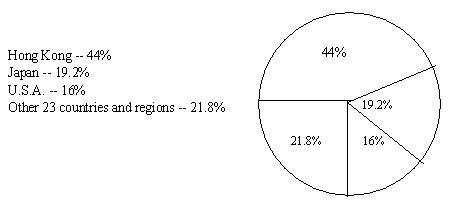
Directions: Study the following pie chart carefully and write an essay entitled “Investment in Beijing from Different Countries and Regions”. Your essay should meet the requirements below:
1. Describe the pie chart,
2. State the possible benefits brought by outside investment,
3. Suggest measures helping to attract investment from outside.
自从1979年中国对外开放以来,北京在吸引外企投资合资企业方面已取得了显著成绩。根据图示,不同企业的投资者来自26个国家和地区。香港的投资额居第一位,占总额的44%。日本占19.2%, 居第二位。美国为第三,占16%。
普遍认为,北京从外部投资中受益匪浅。首先,大量合资企业已经建立,这就大大促进了“首都经济”的发展。其次,外资企业为北京市民提供了许多就业机会。这又缓解了北京的下岗工人问题。最后,由于北京和沿海开放城市一样享有许多优惠政策,所以高科技产业在首都发展迅猛。
至于吸引外资的措施,有如下几点。一方面,我们应该专门努力来改善投资环境, 以便越来越多的外资能流入北京。另一方面,我们应该抓住机遇把目前的外资企业尽可能办好。我深信,随着改革开放政策的贯彻执行,北京将吸引大量外资。
Since China opened its door to the outside world in 1979, Beijing has made remarkable results in attracting foreign business to invest in joint ventures. According to the pie chart, the investors in different enterprises come from 26 countries and regions. The investment of Hong Kong ranks first, accounting for 44 per cent of the total. Japan’s investment makes up 19.2 per cent, putting it in second spot. Third is the United States at 16 per cent.
It is generally believed that Beijing benefits a lot from the outside investment. In the first place, a large number of joint ventures have been set up, which contributes greatly to the development of Capital Economy. Secondly, the foreign-invested enterprises offer a lot of jobs to the residents in Beijing. This in turn relieves the problem of laid-off workers in the city. Finally, the high-tech enterprises in the capital will grow rapidly as Beijing enjoys the same preferential policies as coastal cities open to the outside world.
As far as the measures to attract outside investment are concerned, they are as follows. On the one hand, we should make special efforts to improve the investment environment so that an increasing amount of foreign capital can stream into Beijing. On the other hand, we should take advantage of this opportunity to run the present foreign-invested enterprises as efficiently as possible. I am convinced that with the reform and opening up policy being implemented, Beijing will be a great attraction for foreign investment. (247 words)
作业:1.每天做“复习指导”阅读理解1 — 2篇、英译汉2–3天一篇。 2. 改写本单元作文。3. 词汇要结合书中的内容反复背记。
赠言:1. 一面学习、一面思考,学习使人增加知识,而思考则使人把知识总结成规律,再在实践中转化为解决问题的能力。
2. 现象是多变的,本质是基本不变的, 它是事物内部的因果性、必然性和规律性。所以本质,一般来说,就是规律。只有把握规律的人才能从必然王国过渡到自由王国。
Text 1 考考译文
有许多事情使人们认为艺术家离奇古怪。但是最怪异的事情可能是,艺术家的惟一工作是探索情感,而且喜欢关注那些负面情感。
但情况并不总是这样的。诸如绘画和音乐这样的早期艺术形式最适合于表达喜悦之心。但是从大约19世纪后,随着我们从英国诗人渥兹华斯的水仙花到法国诗人波多雷的邪恶之花,更多的艺术家开始把幸福视为毫无意义的、虚伪的,甚至是令人厌倦的。
你可能会辩解说,艺术对幸福更为怀疑,这是因为现代社会目睹了如此众多的苦难。但是这并不是说,好像以前就没有无休止的战乱、灾难及对无辜者的屠杀。事实上,艺术对幸福怀疑的原因可能恰恰相反:在今天的世界上混账的幸福实在太多了。
虽然这样,那什么是几乎能够完全致力于描绘幸福的一种现代表达方式呢? 广告业。反幸福艺术(=宣扬不幸的艺术)的兴起几乎完全是随着大众媒体的出现而接踵而至的;随之,出现了商业广告文化,其中幸福不仅仅是一种理想,而且还是一种思想意识。
早期的人们到处都能感悟苦难。他们一直工作到筋疲力尽,生活几无保障,年纪轻轻就呜呼哀哉。在西方,在大众宣传工具和阅读书写之前,最有力的大众传媒是教堂。它可以使那些做礼拜的人想到,他们的心灵处于危险之中,有朝一日他们可能会成为坏人的盘中之餐。考虑到这一切,人们也确实不需要让艺术也变成令人不快的东西了。
如今,普通西方人的周围不是宗教信息,而是商业信息以及永远快乐的信息。吃快餐的人、新闻主持人、邮递员,所有的人都在不停地微笑着。我们的杂志为容光焕发的名人和住在漂亮房子里的幸福家庭做特写。因为这些信息有日程安排 -以便诱惑我们打开钱包,它们使幸福的概念变得似乎不太可靠。广告为治疗关节炎的药物Celebrex发出命令:“庆祝!”。可后来我们发现,这种药可能增加患心脏病的风险,
但是我们所忘记的东西,即我们的经济指望我们忘记的东西,是幸福不仅仅是没有痛苦的快乐。那些能够带来巨大快乐的东西也有可能带来巨大的潜在的损失和失望。今天,我们周围到处都是唾手可得的幸福的承诺,我们需要艺术来告诉我们死亡的象征,就像过去一度宗教所做的那样,即记住,人是会死的,一切都会结束;记住,幸福不是否认死亡,而是与死亡共存。这个信息比丁香香烟还苦,但是,由于某种原因,它又是一股新鲜空气。
Text 2 考考译文
美国人不再期望公众人物无论在讲演或在书写中熟练地、天才地掌握英语语言。他们自己也没有这样的雄心。既有自由派又有保守派观点的语言学家兼善辩家John McWhorter在他的近著《Doing Our Own Thing. The Degradation of Language and Music and Why We Should, Like, Care》中认为,20世纪60年代反传统文化的胜利是造成规范英语衰落的原因。
谴责放任的六十年代并不是什么新鲜的事,但是这还不是再次批判教育的衰退。McWhorter先生的学术专业是语言历史和变迁。他认为,诸如“whom”一词的逐渐消失是自然的,与古英语格结尾的消失一样并没有什么可遗憾的。
可是,膜拜真实性和个性化,即所谓“做我们自己的事情”,已经招致了规范语言、作品、诗歌和音乐的衰亡。尽管六十年代以前有一定文化的人写信时也寻求高雅的笔调,但是从那时以来甚至最受好评的作品也一直捕捉报纸上的口头英语。同样,在诗歌中,高度个性化的、极具表演力的风格成了可以称作真正生动活泼的惟一形式。在口头和书面英语中,谈话语体战胜了讲演语体,自发性战胜了工艺性。
来自高低文化层次的大量令人高兴的例子说明,